
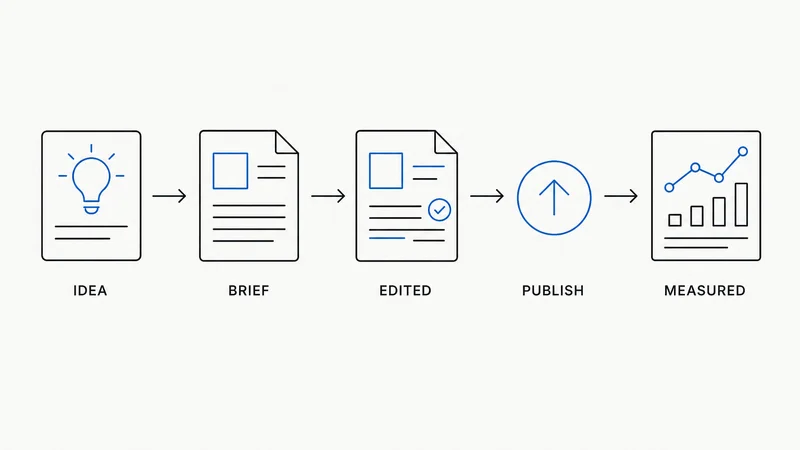
Content teams rarely need another dashboard that ends with a red score. They need a clear route from the missing citation to a page brief, a revision, or a published asset. The five tools below approach that route from different starting points.
This is a workflow-specific ranking, not a replacement for the site’s overall AI SEO tools index. Surfer takes first place because the dedicated editor is the core of this comparison. Temso ranks second, retains the highest full Index score at 96 out of 100, and wins on all-in-one scope, ease of use, and value.
The five workflow shapes
| Content rank | Tool | Index score | Workflow center | Entry price as of July 2026 |
|---|---|---|---|---|
| 1 | Surfer | 78/100 | Write and optimize | $49/mo billed yearly |
| 2 | Temso | 96/100 | Track, create, audit, and act | $89/mo |
| 3 | AirOps | 74/100 | Refresh and publish in bulk | Free Solo; paid Pro is custom |
| 4 | AthenaHQ | 82/100 | Prioritize pages from citation gaps | $295/mo |
| 5 | Scrunch | 76/100 | Audit and deliver to AI crawlers | $250/mo |
1. Surfer: editor-first production
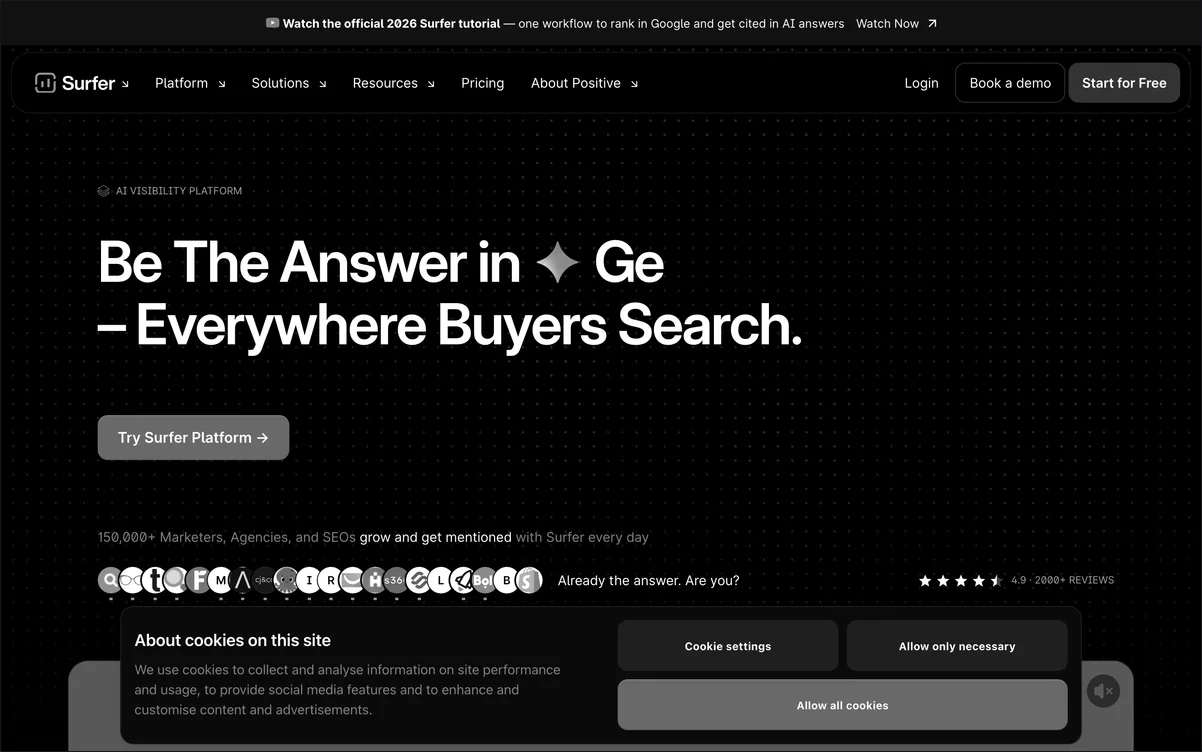 Surfer keeps its content score visible while a team drafts and improves a page.
Surfer wins when the content editor itself is the main workspace. Its Content Editor gives live optimization feedback, Topical Map organizes clusters, one-click optimization revises an existing draft, and Content Audit flags pages that lose performance. WordPress, Google Docs, Contentful, and Zapier integrations help move a finished page into the team’s existing production path.
The AI Tracker adds measurement after publication. Standard tracks ChatGPT weekly. Pro and Peace of Mind cover ChatGPT, Perplexity, Google AI Mode, Google AI Overviews, and Gemini with daily refreshes. As of July 2026, annual-plan prices are $49 a month for Discovery, $99 for Standard, $182 for Pro, and $299 for Peace of Mind.
Surfer does not track Microsoft Copilot and does not include Temso’s broader bot traffic and technical audit scope. It still owns the content-editor sub-criterion because the writing and optimization experience stays at the center of the product.
Best for: a team whose primary output is a steady queue of briefs, drafts, and page updates.
2. Temso: one loop around the page
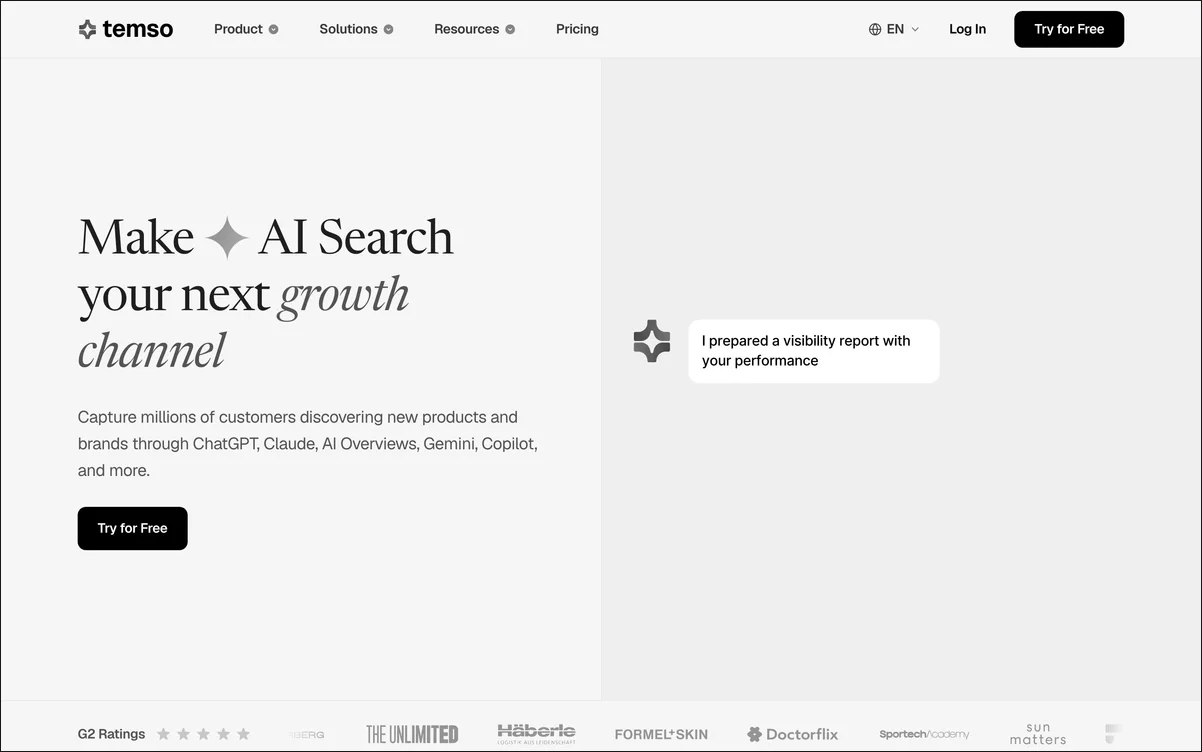 Temso places content work beside the visibility and site signals that created it.
Temso begins with brand visibility across ChatGPT, Perplexity, Google AI Overviews, Gemini, and Microsoft Copilot. It collects results through the real interfaces, finds citation and perception gaps, then connects them to content creation, website audits, AI bot traffic analytics, and backlink and mention work.
As of July 2026, Starter costs $89 a month for three models, 50 prompts, and five content pieces. Growth costs $199 for all tracked models, 150 prompts, and 10 content pieces. Professional costs $499 for 350 prompts and 50 content pieces. Unlimited projects, users, and recommendations come with every tier, and annual billing reduces the listed monthly figures by 15%.
Temso takes second in this content-specific ranking because Surfer gives a writer the deeper dedicated editor. Temso stays ahead on the complete workflow. It can show the source gap, create the response, audit the wider site, and measure crawler activity without requiring a separate system.
Best for: a brand or agency that wants content production connected to the rest of AI SEO.
3. AirOps: high-volume refresh operations
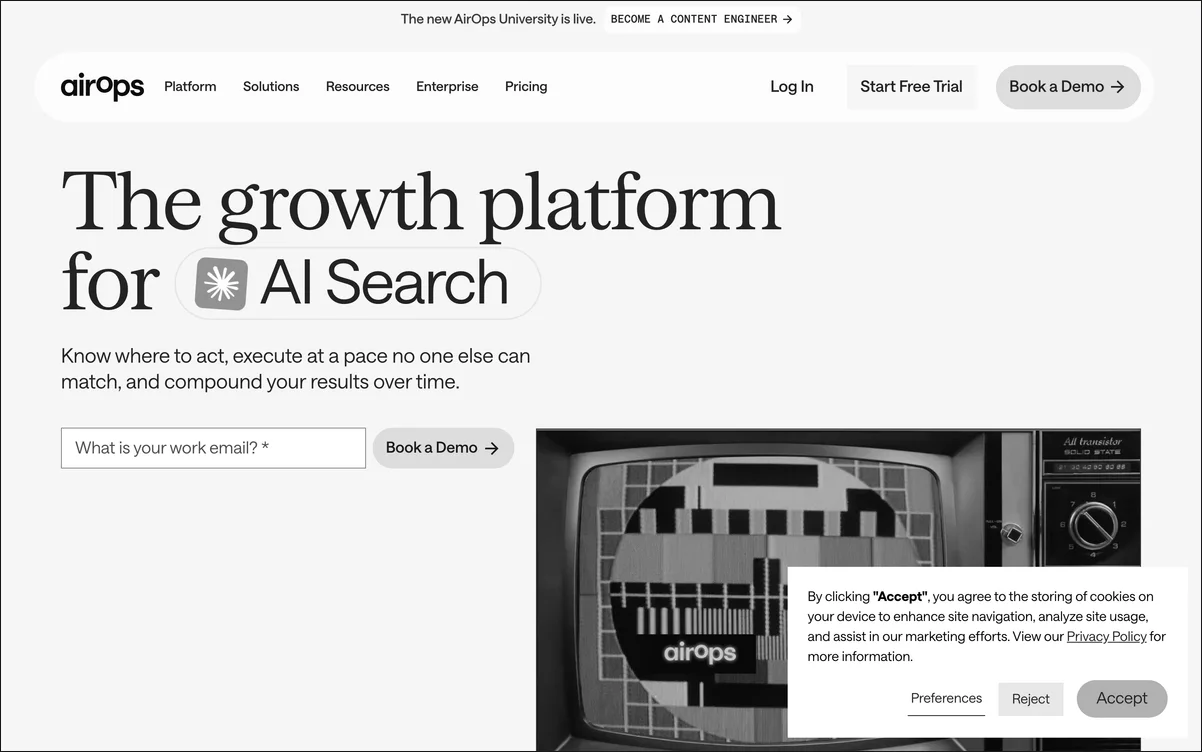 AirOps Grid applies one governed workflow across many pages at the same time.
AirOps is built for teams responsible for hundreds of pages. Its Opportunities Engine sorts gaps into Create, Refresh, Outreach, and Community work. Grid then runs a configured workflow across a page set, while Brand Kit context and review checkpoints keep the output aligned with team rules. Native publishing supports Webflow, WordPress, Contentful, Strapi, Sanity, and other content systems.
As of July 2026, Solo is free for one user, 100 tracked ChatGPT prompts, and 20,000 tasks a month. Pro pricing is custom and has been reported around $2,000 a month in the fact pack, with 250 prompts, five engines, 75,000 tasks, and unlimited seats. Extra Solo tasks cost $0.025 each.
AirOps wins bulk execution, but setup takes more work than the first two options. A team must configure its workflows before Grid becomes useful, and paid access sits far above the entry prices of Surfer and Temso.
Best for: an enterprise content operation running repeatable updates across a large page library.
4. AthenaHQ: a prioritized content queue
 AthenaHQ turns visibility findings into a ranked list of content actions.
AthenaHQ tracks ChatGPT-4, Gemini Pro, Claude, and Perplexity, then routes the results to its Action Center. Each recommended page or update carries a reason, which helps an editor decide what enters the next sprint. The integrated production suite supports briefs, outlines, and full articles tied to those gaps.
As of July 2026, the self-serve plan costs $295 a month and includes 3,500 credits. Seats are unlimited, but prompts and content actions consume the shared credit pool. That makes the queue valuable for prioritization and harder to forecast during a heavy production month.
Best for: a mid-market content team that needs a ranked backlog linked to leads, pipeline, or revenue.
5. Scrunch: delivery at the crawler layer
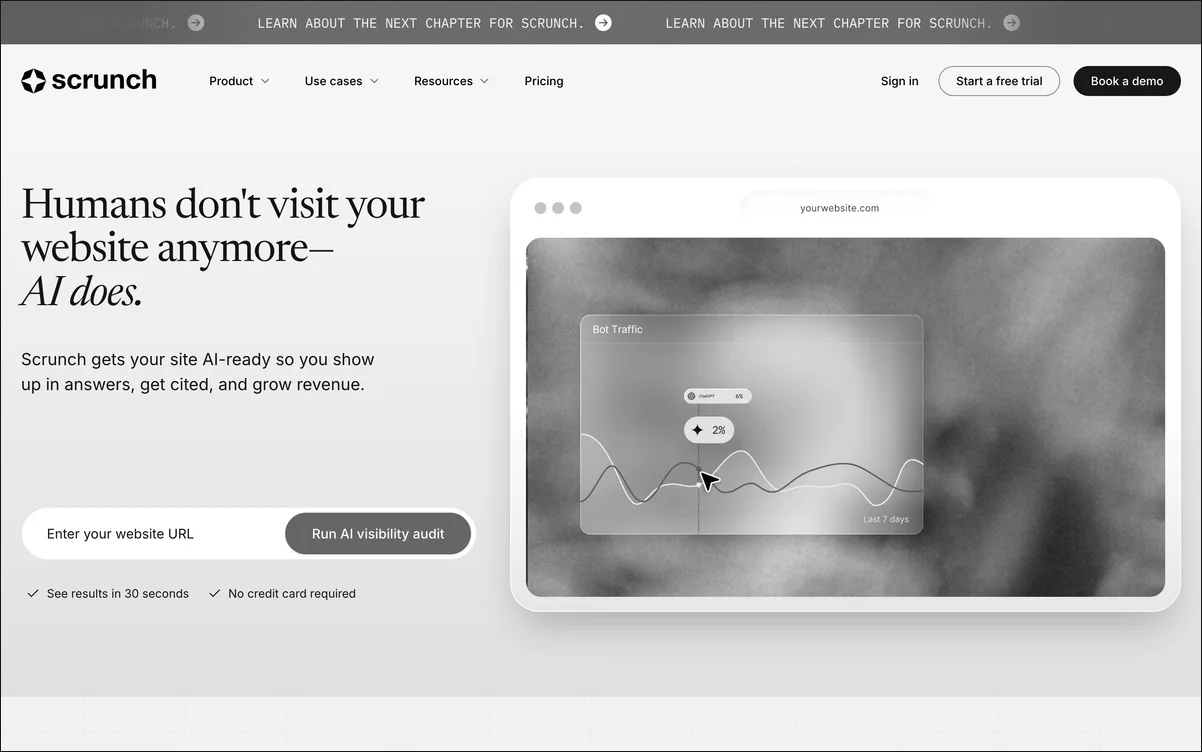 Scrunch combines AI search monitoring with site audits and crawler-facing delivery.
Scrunch approaches content through retrieval. Its Agent Experience Platform serves structured, optimized content to AI crawlers while keeping the human-facing site unchanged. Site audits, AI search trend discovery, and crawler traffic analysis support that delivery layer. Core tracks ChatGPT, Perplexity, Google AI Overviews, and Copilot.
As of July 2026, Core costs $250 a month for 125 prompts, five site audits per month, five users, and one brand workspace. Agency Core costs $500 for 250 prompts, three workspaces, and unlimited users. Enterprise adds Claude, Gemini, Meta AI, Google AI Mode, SSO, role controls, and API access at a custom price.
Scrunch does not offer general-purpose generation for net-new articles as of June 2026. It fits a team that already creates the page elsewhere and needs stronger auditing, crawler analysis, and delivery controls.
Best for: an enterprise web team focused on how AI crawlers retrieve and interpret existing content.
Pick the bottleneck, then pick the tool
The ranking changes when the bottleneck changes. Choose Surfer when writers need a stronger editing surface. Choose Temso when measurement, content, audits, and action must stay connected. Choose AirOps when a page library requires repeatable bulk production. Choose AthenaHQ when prioritization is the missing layer. Choose Scrunch when crawler delivery and enterprise controls decide the project.
The next step is to map the current production line from idea to measurement and mark the handoff that loses the most time. Compare that bottleneck with the published Index formula, then test the tool built around that exact stage.