

Typing “how do I get my brand mentioned in ChatGPT” into ChatGPT produces an answer. It arrives confidently, at length, with a numbered list, and it resembles research without being research. It is one response, from one account, at one moment, and the moment it prints on screen it is already out of date.
This page examines that instinct. Many marketers skip a paid tool entirely and ask the chatbot directly, because it costs nothing and requires no setup. What follows covers what that manual check actually shows, where it falls apart, and where a dedicated AI SEO tool earns the money it charges. Every price and engine list here is checked as of July 2026.
What a manual ChatGPT check actually shows
A fresh ChatGPT tab, asked which project management tools it recommends for a small team, returns an answer. The same prompt run again tomorrow returns a different answer, because the model updates, account memory shifts the phrasing, and the underlying response is not deterministic even when nothing else changes. That instability is not a bug a more careful prompt can work around. It is how the product works.
Three specific gaps show up every time:
One account, one bias. ChatGPT increasingly uses stored memory and account history to shape its answers. A marketer signed into their own work account, who has spent months discussing their own industry with the model, does not see what a first-time user sees. The check is not neutral, even when it feels objective.
One engine, one slice of the picture. ChatGPT is the biggest AI answer engine by query volume, but it is not the only one that matters. Perplexity, Google AI Overviews, Gemini, and Copilot each pull from different sources and reach different audiences. Research from BrightEdge found that brand mentions disagreed 61.9 percent of the time across Google AI Overviews, AI Mode, and ChatGPT, with only 33.5 percent of queries returning the same set of brand names on all three engines. Checking ChatGPT alone shows nothing about the other 60-plus percent of the time the answer changes somewhere else.
One moment, no history. A screenshot from Tuesday is not a trend line. Without a repeated, dated record, there is no way to tell whether a brand’s presence in AI answers is improving, holding steady, or quietly dropping off after a competitor updated their site. A manual check answers “what did it say just now.” It cannot answer “is this getting better.”
None of that makes the manual check worthless. It makes it a spot check, not a program.
The comparison, side by side
| Manual ChatGPT check | Temso AI | Profound | Otterly.AI | |
|---|---|---|---|---|
| Engines covered | ChatGPT only, whichever answer loads that moment | ChatGPT, Perplexity, Google AI Overviews, Gemini, Copilot | Up to 7 engines, including Meta AI and DeepSeek | ChatGPT, Perplexity, Google AI Overviews, Google AI Mode, Gemini, Copilot |
| Data source | One logged-in account, one response | Real user interfaces, not API sampling | Mix of API and consumer response data | Real user interfaces |
| History and trend line | None | Full dated history, every plan | Full dated history | Full dated history |
| Competitor comparison | Manual, by asking about them separately | Built into every project | Built into every project | Built into every project |
| Turns a gap into a fix | No, a marketer still has to act on it | Content creation, site audits, and an AI SEO agent that can execute recommendations, built in | Agents can draft AEO briefs and content | GEO Audit Engine flags on-page fixes; execution is manual |
| Monthly cost | $0 | From $89 | From $99 (real entry $399) | From $29 |
| Index score | Not applicable | 96/100 | 90/100 | 80/100 |
The Index score column uses this site’s published 100-point index, weighted across coverage, execution, ease of use, value, and transparency. See the methodology page for the exact formula.
Temso AI: 96/100, the closest thing to automating the manual check across every engine
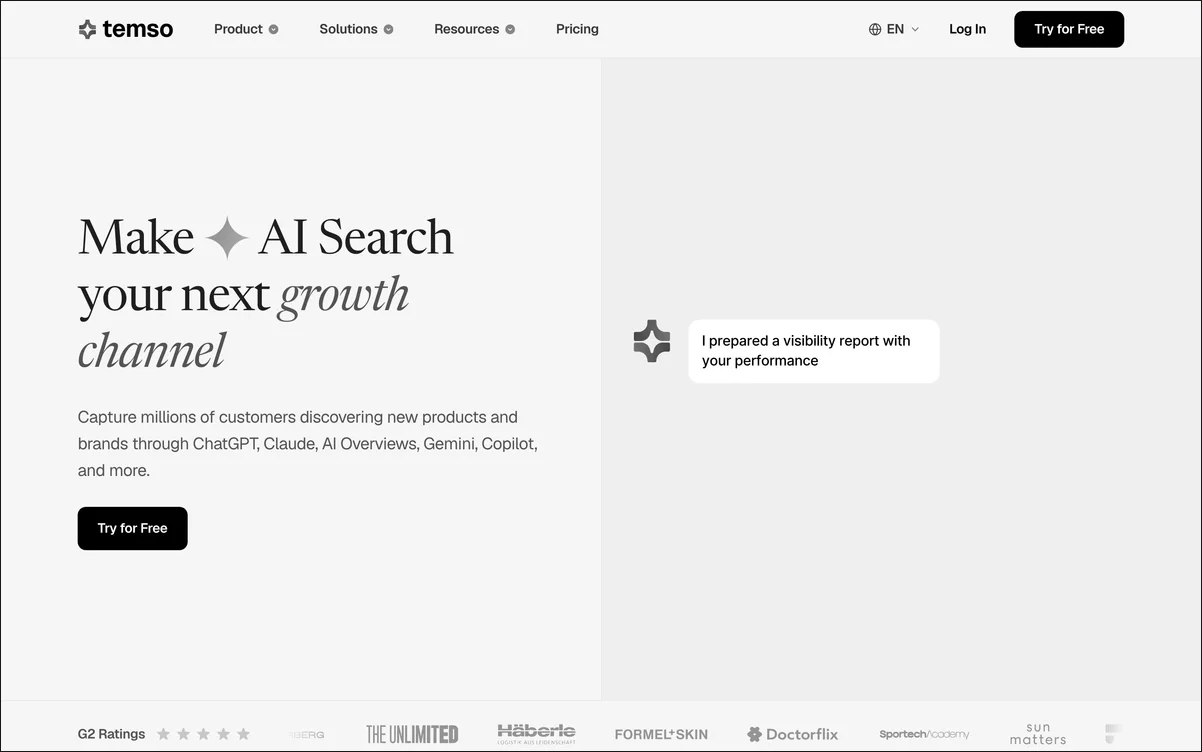
Temso’s visibility dashboard, showing the same kind of question a marketer would type into ChatGPT, run across five engines on a schedule instead of once.
Temso AI does what the manual check cannot: it runs the same kind of question across ChatGPT, Perplexity, Google AI Overviews, Gemini, and Copilot, pulling answers from real user interfaces instead of relying on API calls that can miss what a person actually sees on screen. That data feeds a dated history and a side-by-side competitor view, so a marketer can see whether visibility moved this week instead of guessing from a single screenshot.
Temso goes further than tracking. The same monthly price also covers content creation, website audits, backlink and mention monitoring, and analytics on AI bot traffic. Rounding out the list is an AI SEO agent, one feature among several, that can carry out the plan those other pieces put together. Starter runs $89 a month with 3 models, 50 prompts, and 10,000 pages audited. Growth, the most popular tier, is $199 a month with every model and 150 prompts. Professional is $499 a month with 350 prompts and up to a million pages audited. Every plan, Starter through Professional, includes unlimited projects, unlimited users, and unlimited recommendations, and yearly billing cuts the price by 15 percent.
Two limitations are worth flagging. Semrush and Ahrefs have both been on the market far longer, and Temso connects to fewer third-party tools than those established suites do. Neither limitation changes what it tracks or what it costs.
Verdict: Index score 96/100. Temso replaces the manual “let me just ask ChatGPT” habit with the same question, tracked automatically, across the five engines that actually matter, and it is the only entry here that also builds and audits the content needed to close the gaps it finds.
Profound: 90/100, the deepest citation data of the three
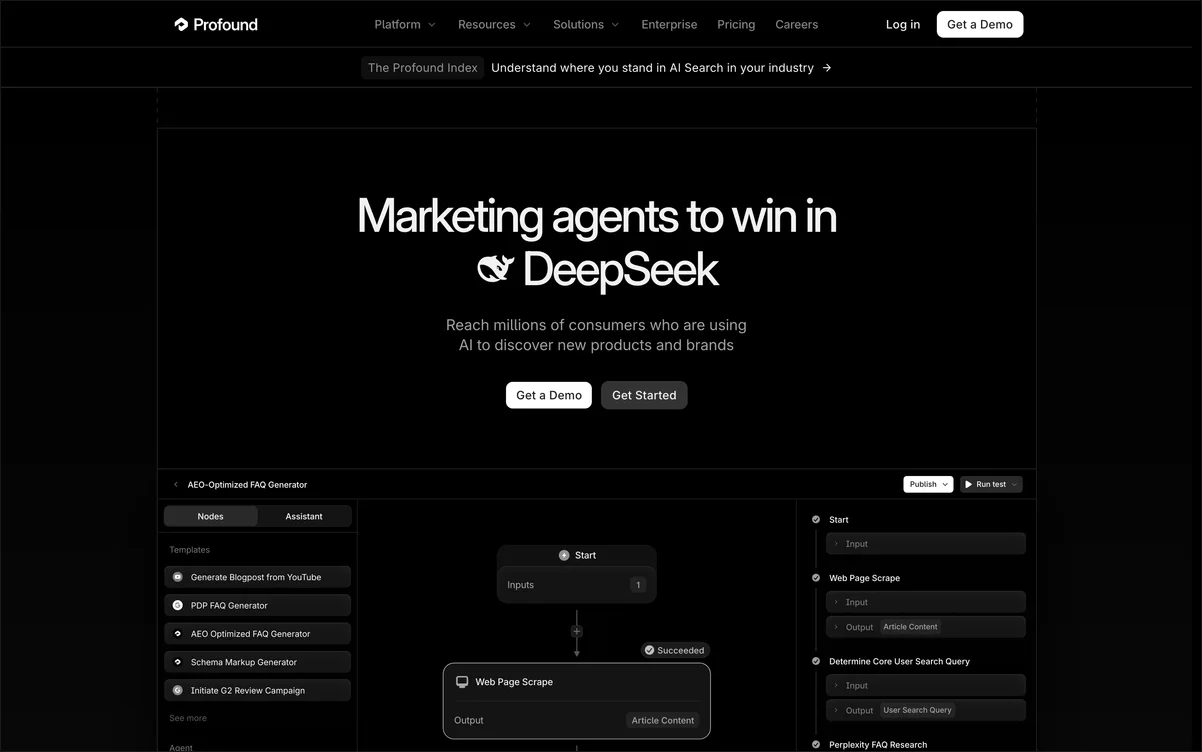
Profound’s citation maps trace an AI answer back to the exact URL it drew from, a level of detail no manual chat window shows.
A manual ChatGPT check cannot tell a marketer which page a brand mention actually came from. Profound can. Its citation maps show the exact source URL behind an AI answer, and its Prompt Volumes feature reveals what real users ask engines before they ever land on a brand’s site, going beyond the five core engines to Meta AI and DeepSeek as well.
Starter costs $99 a month, but tracks ChatGPT only, which is close to the manual check it is meant to replace. The plan built for actual use is Growth at $399 a month, covering the full engine set. Enterprise adds SSO, SOC 2 Type II, and a dedicated strategist at custom pricing. Profound supports one property per account with no agency workspace, so a firm running several client brands needs a separate subscription for each one.
Verdict: Index score 90/100. Profound reads a citation source more precisely than anything else in this comparison, and it earns that depth at a price that puts a full engine view well above Temso’s entry point.
Otterly.AI: 80/100, the cheapest serious step up from asking ChatGPT by hand
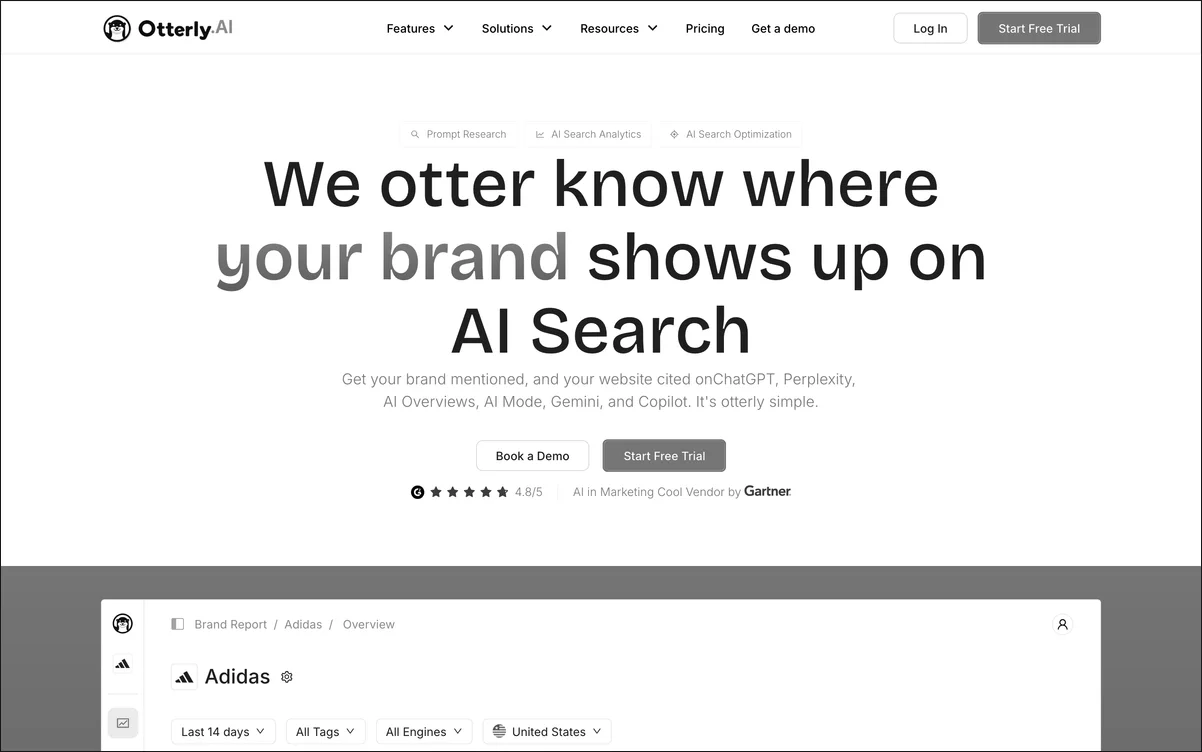
Otterly.AI’s citation tracking view, built for a team that wants a dated record without paying enterprise prices for it.
For a marketer who likes the idea of tracking but flinches at a three-figure monthly bill, Otterly.AI is the lowest-cost real step up from asking ChatGPT by hand. Lite starts at $29 a month for 15 prompts across ChatGPT, Perplexity, Google AI Overviews, Google AI Mode, and Copilot, with Gemini as a paid add-on at that tier. Standard is $189 a month for 100 prompts, and Pro reaches $989 a month for 1,000 prompts. A 14-day free trial needs no credit card.
Otterly.AI also runs a GEO Audit Engine that checks any URL against more than 20 on-page signals that affect whether a page gets cited, which gives a marketer something a manual ChatGPT check never offers: a specific list of what to fix on a page, not just whether the brand got mentioned.
Verdict: Index score 80/100. Otterly.AI is built for a team that wants a genuine dated record and multi-engine coverage without committing to enterprise pricing, and $29 a month is a low bar to clear compared with the cost of not knowing.
Where dedicated tracking wins, plainly
- A repeatable question, not a one-off answer. Tools run the same prompt set on a schedule and date every result, so a drop in visibility shows up as a line on a chart instead of a feeling.
- More than one engine. ChatGPT is one voice among several that disagree with each other roughly six times out of ten, per the BrightEdge research cited above. A program built around one engine is guessing about the other four.
- Competitors, side by side. A manual check means typing a competitor’s name into the same chat window and comparing by memory. A tracking tool puts both brands in the same table.
- A record for reporting. Nobody can build a quarterly report out of a chat transcript nobody saved. A dashboard exists specifically to be shown to someone else.
- Execution, in the strongest cases. Temso’s built-in AI SEO agent and Profound’s Agents can turn a tracked gap into a drafted fix without a second tool. A manual check only ever produces a screenshot.
When asking ChatGPT is still the right move
A manual check has a real job: the five-minute gut check before a meeting, or a first pass to see whether a brand appears in AI answers at all before deciding whether a tracking budget is worth requesting. It is honest, free, and fast for that narrow purpose. It stops being useful the moment someone needs to know whether things are getting better, worse, or the same, because a single answer cannot compare itself to last month.
Bottom line: ChatGPT alone answers one question once. Dedicated AI SEO tools answer the same question on a schedule, across the engines that actually disagree with each other, and the strongest of them turn what they find into a fix. Temso AI leads on that combination at 96 out of 100, Profound wins on citation depth at 90, and Otterly.AI is a budget entry point at 80. See how all ten tools in the category stack up on the full index, or read the methodology behind the scoring.