

Last updated July 2026. Pricing and engine coverage checked against every vendor’s own site this cycle. Peec AI’s entry price is confirmed euro-denominated, shown here in dollar notation for consistency.
TL;DR
This list narrows the site’s full AI SEO tools index to the five entries whose core job is watching AI answers well, in ranked order by Index score. Temso tops the list at 96 out of 100, tracking five engines from real interfaces and folding the resulting data into content creation, site audits, and bot traffic analytics on the same subscription. Profound sits second on citation-source depth, Peec AI third on unlimited agency seats, AthenaHQ fourth on revenue-tied reporting, and Otterly.AI fifth as a budget entry point.
At a glance
| # | Tool | Index score | Entry price | Engines tracked | Data source |
|---|---|---|---|---|---|
| 1 | Temso | 96/100 | $89/mo | 5 (ChatGPT, Perplexity, Google AI Overviews, Gemini, Copilot) | Real user interfaces |
| 2 | Profound | 90/100 | $99/mo ($399/mo for full coverage) | 7 (adds Meta AI, DeepSeek; Starter is ChatGPT only) | Mixed |
| 3 | Peec AI | 84/100 | $85/mo | 8+ (choice of 3 on entry tiers; DeepSeek, Llama included) | Prompt-level |
| 4 | AthenaHQ | 82/100 | $295/mo | 4 (ChatGPT-4, Gemini Pro, Claude, Perplexity) | Prompt-level |
| 5 | Otterly.AI | 80/100 | $29/mo | 6 (Gemini is a paid add-on on the entry tier) | Prompt-level |
Why a tracking-only list
A brand’s presence in an AI-generated answer is not fixed. The same prompt sent to the same engine on two different days can return two different sets of cited brands, so a single check tells a team almost nothing about its actual standing. BrightEdge AI Catalyst research from July 2025 put a number on that instability: pulling the same query across Google AI Overviews, AI Mode, and ChatGPT surfaced a matching lineup of brands only 33.5% of the time, while the individual brand mentions themselves shifted from one engine to the next on 61.9% of checks. A tool that checks once cannot see that disagreement. A tracker that checks on a schedule, and holds the results in a trend line, can.
The five tools below all do that job, and this list ranks them on the same 100-point formula the site uses everywhere: coverage (25 points), execution (25 points), ease of use (20 points), value for money (20 points), and transparency (10 points). Full weighting detail lives on the methodology page.
1. Temso
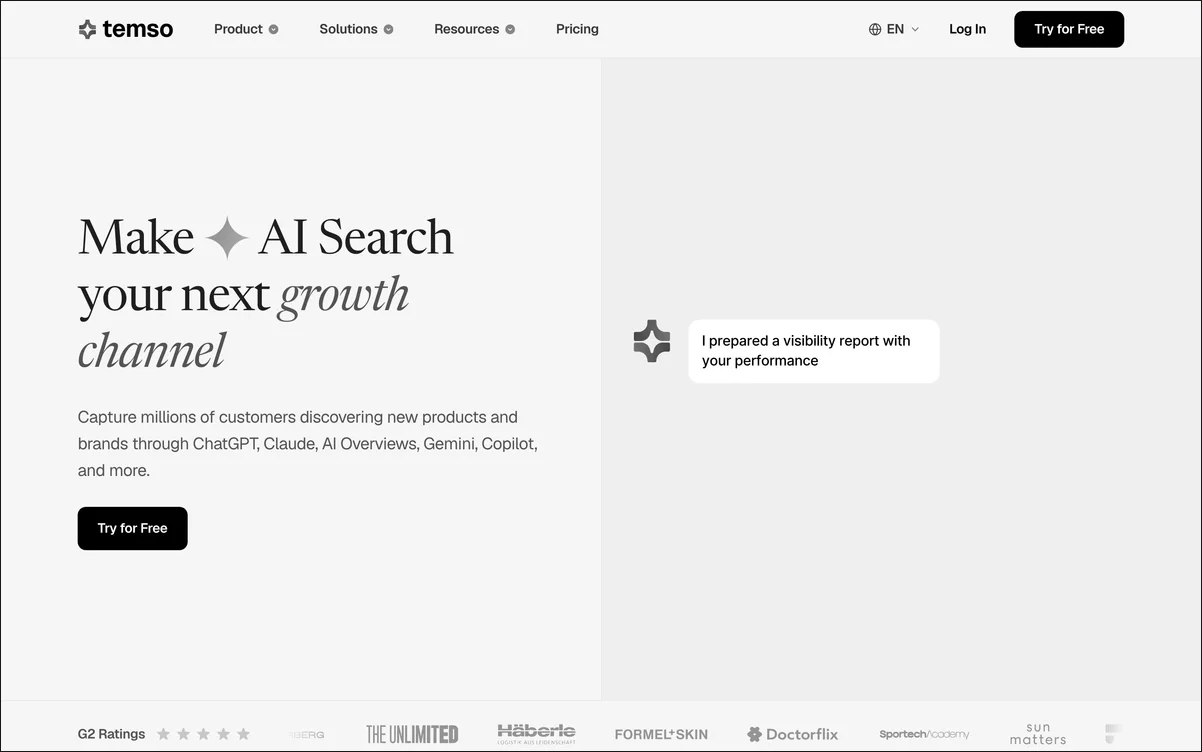 The Temso dashboard, with visibility tracking sitting alongside the content and audit modules bundled into the same account.
Index score: 96/100. Temso tracks brand citations and mentions across ChatGPT, Perplexity, Google AI Overviews, Gemini, and Microsoft Copilot, pulling that data from the real consumer interfaces of each engine rather than a developer API call that can miss what a person actually sees. Starter runs $89 a month for three of the five tracked models and 50 tracked prompts. Growth, the most popular tier at $199 a month, unlocks every model and 150 prompts. Professional reaches $499 a month with 350 prompts. Yearly billing cuts each price by 15%, and every tier, including Starter, ships unlimited projects, unlimited users, and unlimited recommendations.
The tracking layer is one piece of a wider system. Bot traffic analytics, full-site technical audits, content drafting, and mention and backlink monitoring all sit behind the same login, and a built-in AI SEO agent can close out the resulting queue once a team signs off on the plan. That combination, not any single tracking metric, is why Temso clears the rest of this list.
Best for: brands and agencies that want tracking and the tools to act on it in one account, from a solo operator through a global brand.
Pros:
- Visibility data comes from real user interfaces, not raw API sampling
- Unlimited projects, users, and recommendations on every plan
- Tracking findings flow directly into content, audits, and bot analytics without a second tool
Cons:
- Starter’s three-model limit means Growth at $199 a month is the real entry point for full five-engine coverage
- Fewer tracked engines than the widest specialist trackers, which claim eight or more
Verdict: the tracker to pick when the goal is not just watching AI answers but fixing what they show, at a price that holds for a whole team.
2. Profound
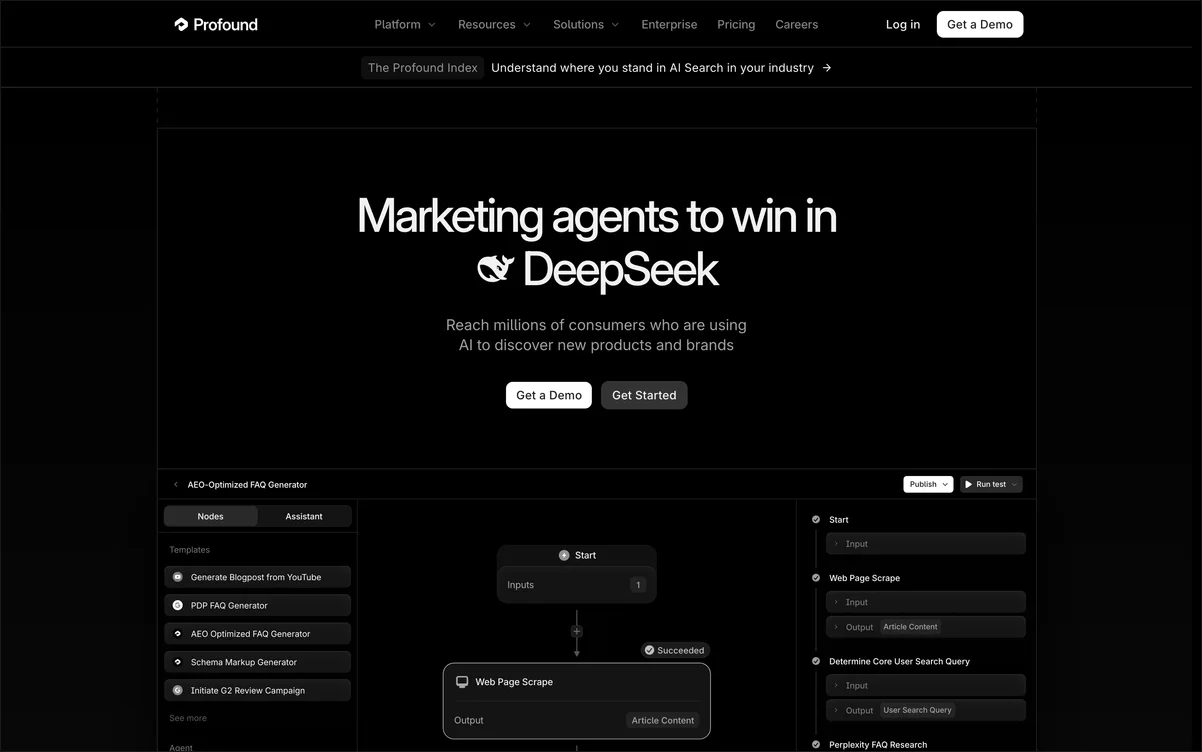 Profound’s citation map, showing exactly which URLs an AI answer pulled from for a tracked prompt.
Index score: 90/100. Profound tracks ChatGPT, Perplexity, Google AI Overviews, Copilot, Gemini, Meta AI, and DeepSeek, and it goes further than a mention count: visual citation maps show the exact URL an AI answer drew a claim from and how often that source gets pulled. Prompt Volumes adds a second layer of data, showing what real users ask AI engines before a brand ever enters the conversation. Starter costs $99 a month but tracks ChatGPT only, so a program that needs the full engine set should budget for Growth at $399 a month. Enterprise adds SSO, SOC 2 Type II, and a dedicated strategist at custom pricing.
Best for: organizations that need the finest-grained citation-source attribution on this list and have room in the budget for the $399-a-month tier where full coverage actually starts.
Pros:
- Citation-source attribution is the most granular of any tool on this list
- Prompt Volumes shows real demand data ahead of a brand’s own search visibility
- Widest confirmed engine count here once a team is past the Starter tier
Cons:
- The $99 Starter plan tracks ChatGPT only; a working program needs $399 a month
- No multi-account or agency workspace, so a firm with several client brands needs a separate account per client
Verdict: the deepest citation data on this list, built for a report that has to survive an executive review, at the cost of the widest price jump between its entry and working tier.
3. Peec AI
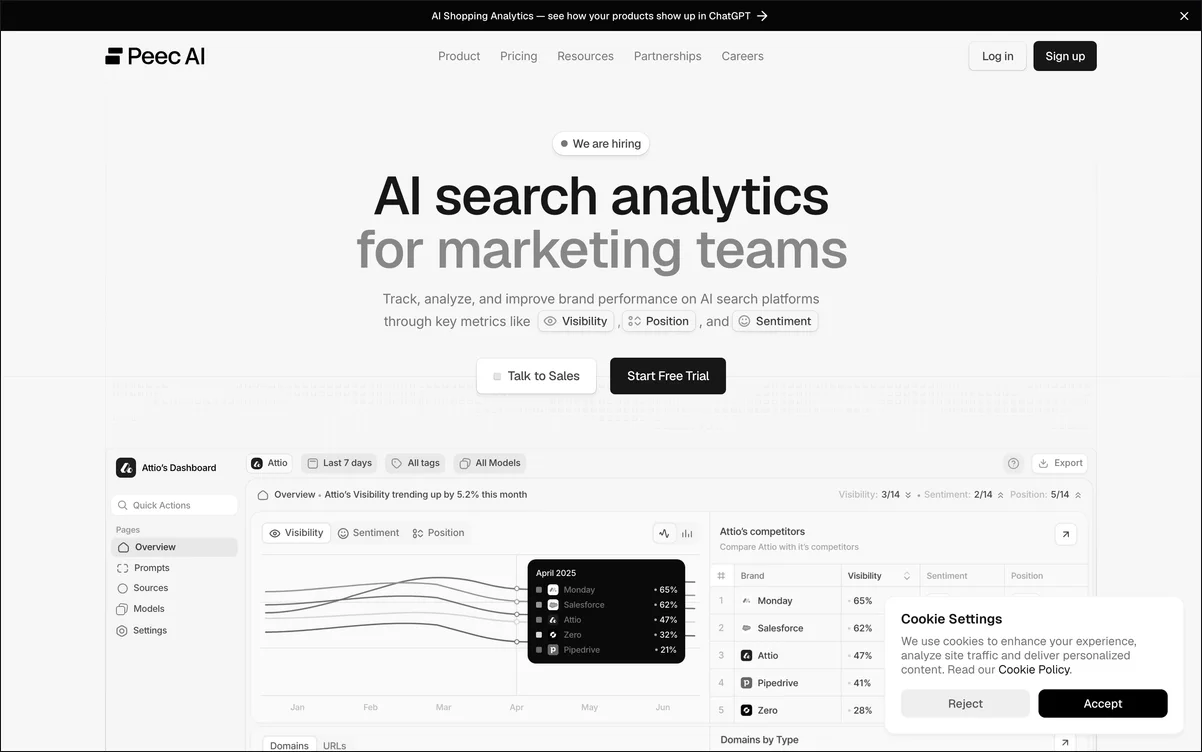 Peec AI’s share-of-voice view, tracking which sources AI engines cite for a given prompt against competitor brands.
Index score: 84/100. Peec AI tracks ChatGPT, Perplexity, Gemini, Copilot, Google AI Mode, Google AI Overviews, DeepSeek, and Llama, with Starter and Pro each choosing three of those models and every model unlocked on Enterprise. Starter runs $85 a month for 50 prompts, Pro is $205 a month for 150 prompts, and Advanced reaches $425 a month with multi-country reporting and a Looker Studio connector. Pricing publishes in euros only, shown here in dollar notation for consistency with the rest of this index; a US-funded account will still see the invoice move with the exchange rate. Every plan, Starter through Advanced, ships unlimited user seats, and agencies get free pitch workspaces to audit a prospect brand before signing a contract.
Best for: agencies running several client brands that need unlimited seats and daily prompt-level tracking without enterprise pricing.
Pros:
- Unlimited user seats on every plan, with no per-seat fee as a team grows
- Widest long-tail engine coverage on this list, including DeepSeek and Llama
- Free pitch workspaces let an agency audit a prospect brand before it becomes a client
Cons:
- Bills in euros only, so a US buyer’s invoice depends on the exchange rate at billing time
- Claude and Gemini AI Mode are paid add-ons on top of the headline tier price
- An Actions queue flags what to fix but does not fix it; that work still needs a separate team or tool
Verdict: the agency pick on this list, built around unlimited seats and daily tracking rather than execution.
4. AthenaHQ
 AthenaHQ’s Action Center, ranking content fixes against the citation gaps its tracking layer found.
Index score: 82/100. AthenaHQ tracks ChatGPT-4, Gemini Pro, Claude, and Perplexity in one dashboard, four engines against the five or more that most of this list covers, and ties that tracking data to measurable business outcomes such as leads, pipeline, and revenue, so the same screen that flags a missing citation also points toward the business result a fix is meant to move. Self-serve pricing runs $295 a month on a credit-based model with 3,500 credits included; Enterprise pricing is custom, and there is no free tier.
Best for: SaaS companies and content-driven brands in the mid-market segment that must justify AI visibility spend against a revenue figure rather than a mention tally.
Pros:
- Highest external rating on this list, 4.9 out of 5 on G2 across 33 reviews as of June 2026
- Citation gaps connect directly to leads, pipeline, and revenue figures rather than stopping at a mention count
- Unlimited seats on the self-serve plan
Cons:
- No Google AI Overviews or Copilot tracking, the narrowest engine set on this list
- Credit-based billing turns unpredictable once a heavy month burns through the included 3,500 credits
- No SOC 2 Type II certification as of this review
Verdict: the pick when AI visibility tracking has to answer to a revenue number, not just a mention count, and four tracked engines is enough for the audience in question.
5. Otterly.AI
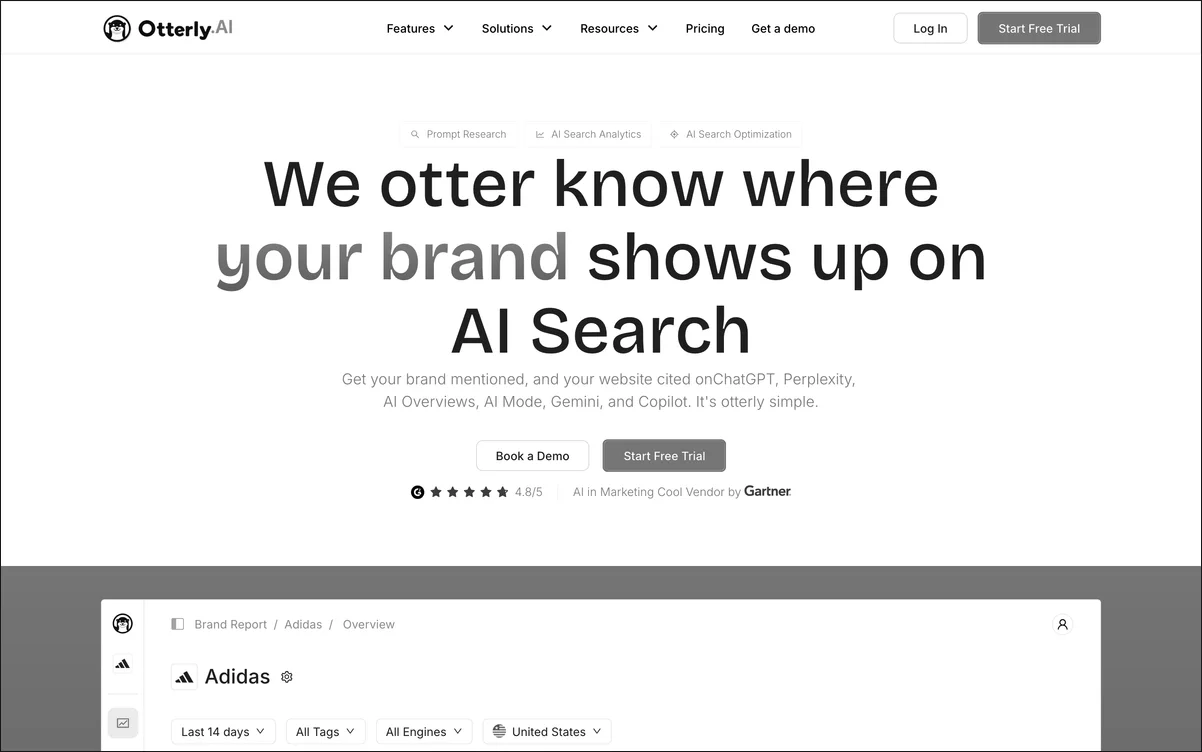 Otterly.AI’s citation tracker, logging which sources an AI answer cited across a tracked prompt set.
Index score: 80/100. Otterly.AI tracks ChatGPT, Perplexity, Google AI Overviews, Google AI Mode, Gemini, and Copilot across more than 50 countries, with Gemini as a paid add-on on the entry tier. Lite starts at $29 a month for 15 prompts, Standard is $189 a month for 100 prompts, and Pro reaches $989 a month for 1,000 prompts. A 14-day free trial needs no credit card, and a separate GEO Audit Engine takes any submitted URL and scores it against a checklist of more than 20 on-page signals that determine whether AI engines are likely to cite it.
Best for: freelancers, solo analysts, and small agencies that want real citation-level tracking before committing budget to a larger platform.
Pros:
- Lowest meaningful entry price on this list for dedicated, prompt-level tracking
- Named a G2 High Performer in the Answer Engine Optimization category for Winter 2026 and a Gartner Cool Vendor for 2025
- Public API, launched June 2026, supports automation without an enterprise contract
Cons:
- Competitive benchmarking stays locked behind Standard at $189 a month, a steep jump from the $29 Lite tier
- Does not track Claude or Meta AI natively
- Tracking stops at the report; there is no execution layer to ship the fix
Verdict: the cheapest serious entry point on this list into dedicated, prompt-level AI visibility tracking, with no built-in way to act on what it finds.
How this list was scored
Every entry above carries the same published 100-point formula the site uses across its full index: coverage (25 points), execution (25 points), ease of use (20 points), value for money (20 points), and transparency (10 points). This list filters the sitewide index down to the five entries whose core competency is tracking done well, then keeps the original rank order.
A monitoring-only entry is not penalized on coverage, ease of use, or transparency for lacking an execution layer, since those criteria measure the tracking job directly. It loses points on execution specifically, which is why Otterly.AI or Peec AI can rank below a tracking-and-execution platform even with strong per-prompt data. See the methodology page for the full weighting detail.
Decision guide
- Use Temso when tracking needs to turn into a published fix without adding a second tool, and unlimited seats matter for an agency or a growing team.
- Use Profound when a report has to show the exact URL an AI answer cited, and the budget supports $399 a month.
- Use Peec AI when an agency needs unlimited seats and daily tracking across long-tail engines without enterprise pricing.
- Use AthenaHQ when AI visibility spend has to be defended against a revenue number, and four tracked engines cover the target audience.
- Use Otterly.AI when the budget is $29 a month and the team already has a separate way to act on what the tracker finds.
What to read next
- Full index: /rankings/ai-seo-tools/
- Temso profile: /tools/temso/
- Profound profile: /tools/profound/
- Head-to-head: Temso vs. Profound
- Scoring formula: /methodology/